
By Anthony Hammill
The 1891 Great Shearers’ Strike was a pivotal event in Australian history, one which impacts our way of life and standard of living today. It was also a period in which Queensland became a powder keg, to the point where it is widely acknowledged that we came perilously close to civil war.
The 1880’s were a time when workers began to realise the benefits of forming unions and engaging in collective bargaining to further their goals of achieving decent wages and working conditions.
The Queensland Shearers’ Union was established in 1887, and the Queensland Labourers’ Union in 1888. One of their goals was to unionise the workplace, as free or ‘scab’ labour undermined their efforts to achieve wage justice.
Employers, of course, saw unions as a threat to their power and profits, and pushed for ‘freedom of contract’ whereby each man negotiated wages and conditions with his employer — in effect, the weak bargaining with the strong. And conservative, unrepresentative colonial governments backed the employers.
Matters came to a head Australia-wide in the 1890’s, a decade of drought, poverty, bank crashes, strikes and widespread unemployment. A maritime black ban on wool shorn by non-unionists at Jondaryan Station on the Darling Downs in 1890 was successful and spread to Sydney, but mounted police drove back unionists trying to block wool wagons reaching the docks.
The Maritime Strike of 1890 in Melbourne was a result of the Steamship Owners’ Association refusing to negotiate with the Marine Officers’ Association until they disaffiliated with the Trades Hall Council.
The strike spread to seamen, wharf labourers and Newcastle and Broken Hill miners, involved 50 000 men, but failed after three months.
A mass meeting of 60 000 people in Melbourne prompted the Victorian government to invoke the Unlawful Assemblies Act and call out the military, and Colonel Tom Price threatened deadly force.
In Queensland, the Shearers’ Strike was precipitated by George Fairbairn junior, whose company controlled more than 20% of the Queensland pastoral industry.
At his Logan Downs station near Clermont on 5 January 1891, his associates presented the shearers with a non-negotiable contract organised through the United Pastoralists Association.
This was simply a union-busting manoeuvre and made no pretence at being even ‘free contract’. The unionists refused to sign, and the strike was on.
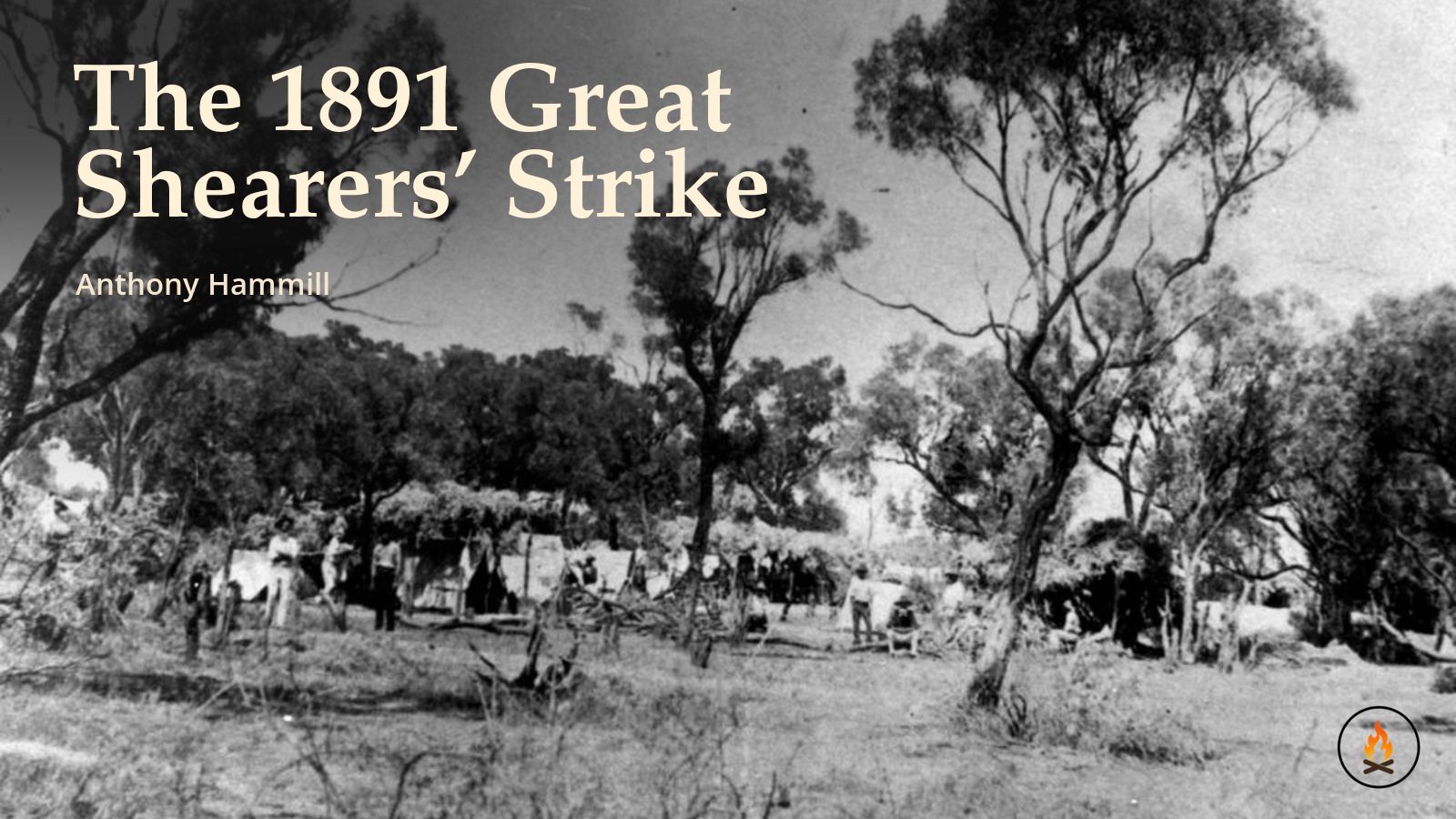
Space does not permit lengthy details of the course of the strike. Strike camps were established and a strike committee formed at Barcaldine (meetings were probably never held under the so-called ‘Tree of Knowledge’). Fairbairn shipped in scab workers lured by pay well above going rates, whom unionists tried to convert through ‘moral persuasion’.
The Queensland government sent 2000 soldiers and police, including the ‘specials’ to hotspots. The unionists drilled with sticks in military style and stockpiled rifles. Incidents such as the ‘Clermont riot’ occurred and unionists arrested.
Unionists were dispersed at the point of the bayonet or sword. The Eureka flag was prominently displayed in some camps, five wool sheds burnt down, telegraph lines cut, large grass fires lit, and scabs or blacklegs and wool wagons protected by armed troops.

Henry Lawson wrote ‘Freedom on the Wallaby’ in support of the shearers. Altogether 245 unionists were jailed on the slightest pretext, and 12 (the St Helena 12) sentenced to 3 years by Judge George Harding in Rockhampton on the catch-all charge of conspiracy.

The strike was called off in June, another followed with no better success in 1894, but a revolution did indeed occur. The strike propelled labour into politics, and in 1899 Anderson (Andrew) Dawson formed the world’s first Labor government in Queensland, if only for a week.
In 1904 John Watson became Australia’s and the world’s first Labor Prime Minister.
My full article is in issue 20 of History Queensland Magazine (Boolarong press Brisbane).
This article appeared in the ‘Land of Legends’ section of eMuse, Vol. 9 No. 10, October 2020, pp. 8–9.
Featured photograph: Union camp at Barcaldine, 1891, John Oxley Library, State Library of Queensland.

Tony Hammill
Award-Winning Bush Poet • Australian History Writer • Researcher • Retired Teacher
Tony Hammill is an award-winning bush poet and Australian history writer whose research explores folklore, historical figures and the stories behind Australian legends.