
By Tony Hammill
Warnings only save lives when they reach the people in danger. During the Black February floods of 1893, Queensland’s telegraph lines were down, rivers were rising and Brisbane was facing another devastating flood. From Caboonbah Station, Henry Plantagenet Somerset sent stockman Billy Mateer over the D’Aguilar Range towards North Pine to carry a warning for Brisbane — a ride no ordinary rider would have attempted.
Billy did not ride along a safe, established highway. He crossed flooded creeks, rough bush tracks and the D’Aguilar Range in torrential weather. He rode more than forty miles, probably taking at least seven hours, with one horse after the second had broken loose during the dangerous river crossing at Caboonbah.
The telegram he carried became tangled in the machinery of official communication. The ride itself was nearly swallowed by time. Yet the surviving evidence points to something remarkable: in February 1893, William “Billy” Mateer made one of the most extraordinary rides in Australian history.
A stockman from the Queensland bush
William Mateer was born in 1870 at Euroombah Station near Taroom in central Queensland, the son of David Mateer and Eliza Mateer, née Kennedy. His parents were Irish immigrants. He later worked as a stockman on William Kent’s Dalgangal Station near Eidsvold, driving cattle towards Brisbane through the Brisbane Valley.
There are gaps in the surviving record of Billy’s early life, but the accounts that remain agree on the important point: he was an experienced bushman and a highly capable horseman. He was reputed to have dealt in horses as well as worked with cattle. That combination of judgement, nerve and horsemanship would be tested to its absolute limit during the floods of 1893.
Black February and a river rising
February 1893 brought a succession of cyclones and rain systems to Queensland. The catchments around the Brisbane and Stanley rivers were already saturated when more heavy rain arrived. At Crohamhurst, more than 900 millimetres of rain was recorded in twenty-four hours — a rainfall figure that remains part of the story of one of Queensland’s great natural disasters.
At Caboonbah, Henry Plantagenet Somerset had an extraordinary view over the junction of the Stanley and Brisbane rivers. During the first major flood he watched the water rise and understood that people downstream were in danger. He sent Harry Winwood, a stockman and bullock driver, towards Esk with a warning for Brisbane.
The first warning was eventually reported in the Brisbane Courier. But later in the month, after another cyclone crossed the coast, the danger returned. This time the upper Brisbane River was rising, the telegraph line through Esk was out and Henry Somerset needed another way to get a message towards Brisbane.

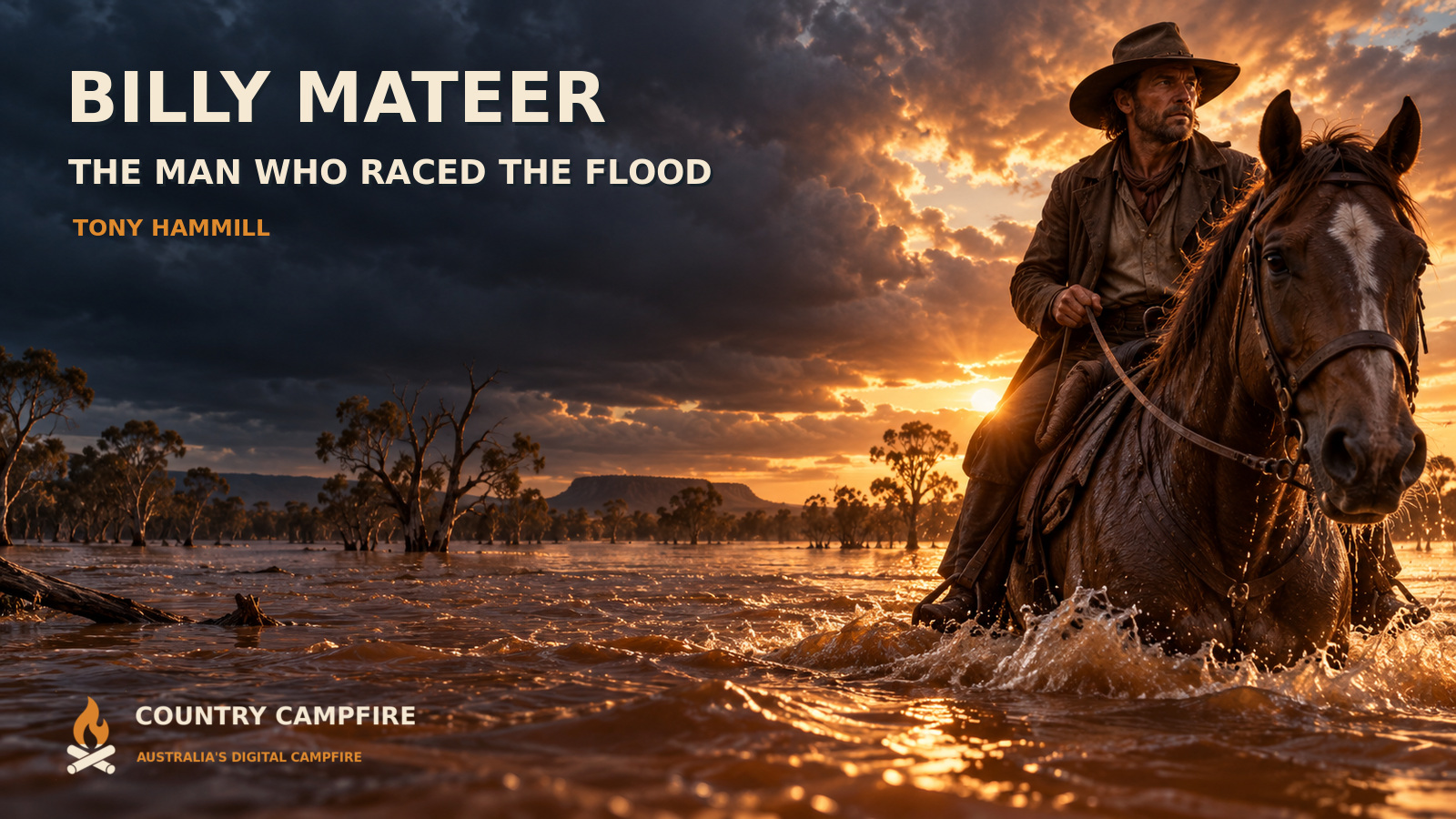
Tony Hammill commissioned this painting from North Coast artist Pam Hopkins in 2009. It captures the danger and movement of a ride that is otherwise preserved mostly through written accounts, oral history and later research.
The ride to North Pine
The exact date of Billy’s ride was not always known. After examining the meteorological evidence and the timing of the floods, Tony Hammill places it most likely on Friday 17 February 1893. That reconstruction makes sense of the circumstances: the warning had to be sent during daylight, the river had already risen beyond the 1890 level and the message needed to reach the telegraph office before it was too late to be useful.
Henry Somerset’s account describes how he and Billy crossed the flooded Brisbane River by boat, with two horses swimming behind them. The horses were Oracle and Lunatic. Oracle broke loose and swam back, leaving Lunatic as the only horse available to carry Billy on the long journey.
From there Billy had to make his way towards North Pine, now Petrie. The route took him through Reedy Creek and across the D’Aguilar Range. These were not formed roads in the modern sense. They were rough bush tracks, creeks and crossings that could become deadly in ordinary heavy rain — let alone during a cyclone-driven flood.
Ellis Campbell, a respected horseman and bush poet, estimated that the ride would have taken at least seven hours if it was completed in daylight. Tony’s research places the distance at roughly forty to forty-five miles. Billy and Lunatic had to cover that country in appalling conditions, with the horse’s strength and the rider’s judgement being tested at every crossing.
It was not enough simply to ride fast. Billy had to know when to let Lunatic recover, where the ground was safe enough to cross and when the water was too dangerous to challenge. A horse pushed beyond its limits would fail, and the mission would end with it.
At North Pine, Billy reached the telegraph office and passed on Henry Somerset’s warning. The ride had succeeded. The message had made it through.
What evidence survives?
For many years the story sat uneasily between history and folklore. It was repeated locally, but Billy’s name was not widely remembered. The evidence was scattered across newspaper reports, personal recollections and later historical work.
The most important early account came from Henry Somerset himself. In an article about the 1893 floods published in the Esk Record in 1932, he described Billy as a “good game stockman” and recorded the river crossing, the two horses, Oracle breaking loose and Lunatic carrying Billy safely to North Pine.
Billy’s wife, Johanna, also provided an important piece of evidence in a 1958 letter to the Courier-Mail. Her recollection confused parts of the two flood rides, but she remembered the essentials: her husband had carried the flood warning, he had crossed flooded waterways and the message had not received the attention it deserved.
The strongest direct evidence came to light in 2011, when correspondence between Billy Mateer and Henry Somerset was discovered in the Brisbane City Council archives. Billy confirmed that he had got through with the message. The correspondence also records that, on the return journey, Lunatic became bogged and was presumably put down — a sad ending to an extraordinary feat of horsemanship.
There was oral evidence as well. Tony recalls being told by Paddy Brennan, an old Somerset Dam local, that Henry Somerset had sent a rider across the range to warn Brisbane during the 1893 floods. Paddy’s family had longstanding connections with the Somerset family, and the story had been handed down in the district.
Taken together, Henry’s 1932 account, Johanna Mateer’s recollection, the 2011 correspondence and the oral evidence all point in the same direction: Billy Mateer reached North Pine with the warning.
The telegram that disappeared into the system
The ride was completed, but what happened to the telegram afterwards is less certain. The warning was sent from North Pine, and Tony Hammill believes that may have caused confusion. An official receiving a message identified as coming from North Pine might have assumed that it referred to flooding in the Pine River rather than the Brisbane River catchment.
That explanation cannot be proved beyond doubt. The original telegram has not survived, and some of Henry Somerset’s later recollections appear to have blended details from the first and second flood warnings. But the theory helps explain why a message carried through such dangerous country did not produce the clear public response Somerset intended.
In the end, the administrative failure should not be allowed to obscure the achievement of the rider. Billy’s responsibility was to get the warning through. He did that. What happened after the message arrived was outside his control.
A ride measured in skill, not mythology
Billy Mateer’s ride has sometimes been compared with Paul Revere’s famous warning ride. The comparison is useful only up to a point. Revere travelled along established roads and rode as part of a wider effort. Billy travelled alone through rough bush country, flooded creeks and a difficult mountain range in cyclonic conditions.
There is no need to diminish one story to appreciate the other. Billy’s achievement stands on its own terms. He had to draw every possible mile from Lunatic without exhausting the horse. As Ellis Campbell observed, the finest riders understood exactly when a horse needed to blow and how fast it could safely travel.
That is what makes the story more than a piece of dramatic folklore. It is a story about practical bush skill: reading water, understanding horses, choosing a line through dangerous country and continuing when the consequences of failure were serious.
A man nearly lost to history
Billy married Johanna Jardine in 1902. He later moved to Brisbane and worked in the tramways. He died in 1934 and was buried at Toowong Cemetery. Despite the scale of his achievement, his name faded from public memory.
There is apparently only one surviving photograph of Billy, showing him as an older man. Family photographs may have been lost in a house fire, although that part of the story remains uncertain. By the time Tony began researching Billy, many people who knew the history of the Brisbane Valley and the Somerset Dam district had never heard his name.
That neglect is one of the reasons the story deserves to be told again. Heroes do not always receive monuments, newspaper headlines or a place in schoolbooks. Sometimes their stories survive because one family remembers, one researcher keeps asking questions and one writer refuses to let the name disappear.
Keeping Billy’s ride alive
Billy’s story has gradually begun to return to public view. The 1999 film Deluge, produced by Brian Benson and Denise Bender, helped share the story with a wider audience. Poems have been written about the ride, and Billy Mateer poetry competitions have been held in Queensland.
Tony Hammill’s research and the painting by Pam Hopkins add another layer to that work of remembrance. The painting does not pretend to be a photograph. Instead, it gives shape to the moment: the horse fighting the water, the rider leaning into the weather and the immense landscape making the human effort look almost impossible.
Whether the ride is described as heroic, historic or simply the work of an exceptionally capable stockman, the conclusion is the same. Billy Mateer carried a warning through conditions that could easily have killed him. He reached North Pine. He got the message through. For more than a century, that achievement deserved far more recognition than it received.
Why Billy Mateer still matters
Australia’s history is full of people whose names are familiar only in the places where they lived and worked. Billy Mateer is one of them. His story connects the realities of early Queensland life — horses, stock routes, rivers, telegraph lines and isolated communities — with the larger history of Brisbane’s great floods.
It also reminds us that history is not always preserved by official recognition. Sometimes it is carried forward by local memory, family stories and people willing to do the patient work of checking what really happened.
Billy Mateer’s ride belongs around the campfire because it is the kind of Australian story that should not be allowed to vanish: a hard ride, a good horse, a dangerous country and a man who kept going when the flood was coming.
Sources and further reading
- Tony Hammill, Billy Mateer: The Man Who Raced the Flood, research manuscript supplied to Country Campfire.
- State Library of Queensland: “Stockman Billy Mateer saves the day!”
- H. P. Somerset, “The 1893 Flood”, Esk Record, 1932, via Trove.
- Margaret Cook and Annabel Lloyd, “Unpacking a Legend”, Circa: The Journal of Professional Historians, 2018.
- Brisbane City Council archives correspondence between Billy Mateer and Henry Plantagenet Somerset, discovered in 2011 and described in Tony Hammill’s supplied research.
This article is based on Tony Hammill’s supplied research. Where the surviving evidence allows more than one interpretation, that uncertainty has been identified rather than presented as settled fact.

Tony Hammill
Award-Winning Bush Poet • Australian History Writer • Researcher • Retired Teacher
Tony Hammill is an award-winning bush poet and Australian history writer whose research explores folklore, historical figures and the stories behind Australian legends.