
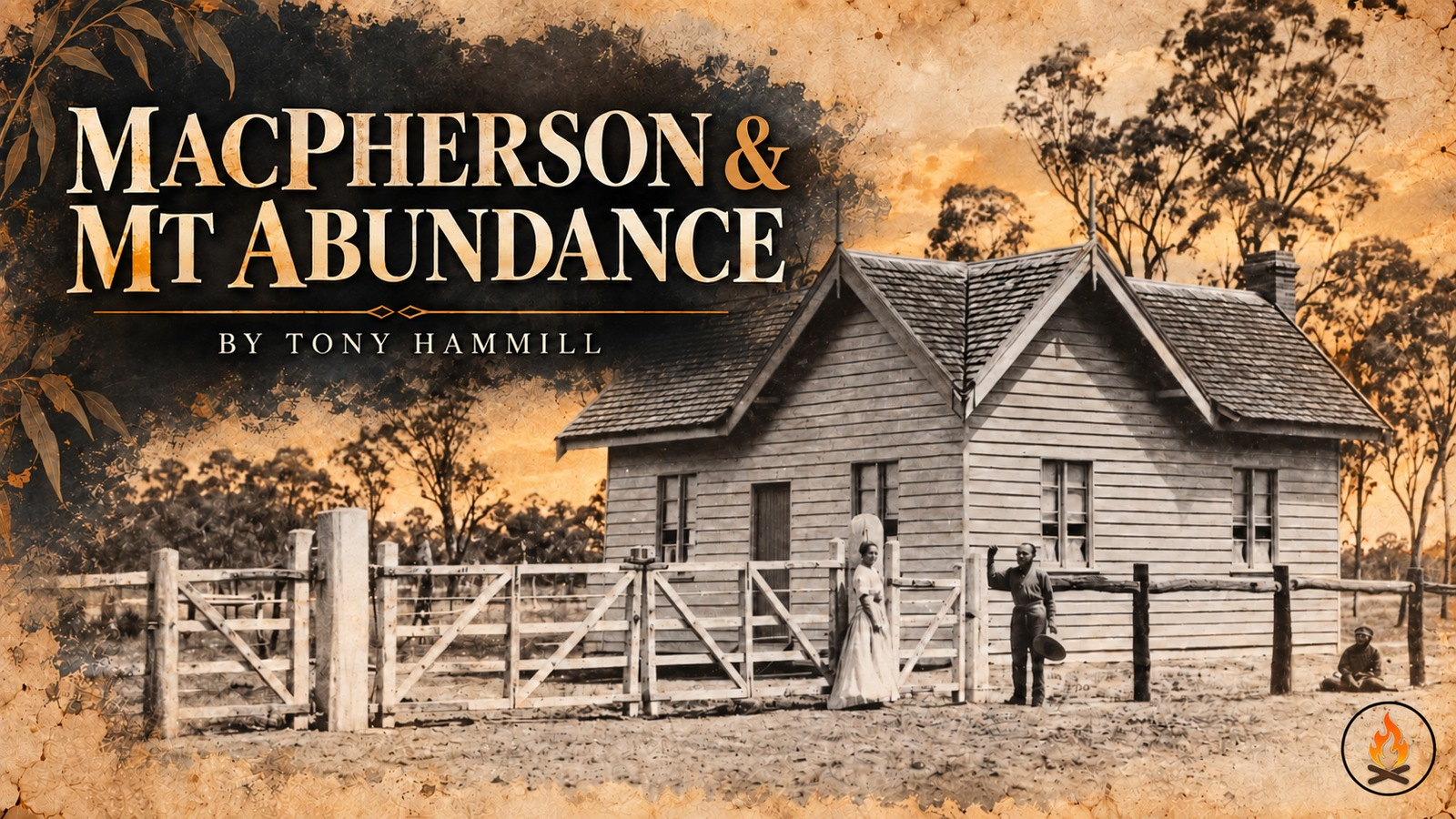
By Tony Hammill
The trials and tribulations of a squatter founding a new pastoral station are no better represented than in Allan Macpherson’s memoir Mount Abundance: or The Experiences of a Pioneer Squatter In Australia Thirty Years Ago, published in 1879. Drawing on the entries in his journal, Macpherson recounts the hardships and tragedies that led to his acceptance of defeat and eventual sale of his run ‘for a song.’
Allan Macpherson (1818-1891) was born at Blairgowrie House, Blairgowrie, Perthshire, Scotland, of a wealthy family. He came to Sydney with his parents in 1828 where his father had accepted a government appointment. He was educated at Cape’s school, and in 1847 found himself a struggling squatter on Keera Station in the Gwydir district in northern New South Wales.
Sir Thomas Mitchell, a fellow Scot and friend of the Macphersons, told them of magnificent grazing country, ‘champagne country’ about 360 miles to the north-west of Keera, which he had discovered on his 1846 expedition. He had named the prominent feature there Mt Abundance. Allan, recognizing opportunity when he saw it, determined to be the first to settle on the best of the land under squatters’ rights and make his fortune. He hoped to make 10 000 pounds a year.
Armed with insider information including sketches from Mitchell, in July 1847 he set out to find his self-described Promised Land. His expedition consisted of twenty men, a superintendent, around 10 000 sheep, several hundred cattle, four loaded drays each pulled by ten bullocks, a small horse team and several saddle horses. Five miles a day was considered a good day’s journey for such an expedition through trackless scrub, but in two months the expedition averaged only 2 ½ miles a day, the main problem being lost animals, and drays being left behind until replacement bullocks could be purchased from the nearest stations. Macpherson himself was absent for a month on business in the Darling Downs.
Crossing St George’s Bridge, a rocky crossing on the Balonne River, they left the last outpost of settlement with 180 miles to go. Leaving the superintendent with the lambing sheep, Macpherson and his personal servant forged on ahead and on 15 October reached their goal, which he described as ‘beautiful undulating downs covered with the richest barley grass and intersected with creeks and gullies.’ He claimed 600 square miles of well-watered land, establishing a sheep station and also a cattle station where Roma now stands, and building his homestead on the southern bank of Bungeworgorai Creek.

Macpherson understandably fails to mention some humorous incidents that occurred along the way. Henry Stuart Russell, the pastoralist and historian who wrote The Genesis of Queensland records that he came across the expedition, and found Macpherson sitting sadly under a tree, and his men lying around, clearly in pain. As Macpherson explained:
“I’m not going into the bush like a savage. I have a good cellar here, a piano, cigars, eau- de- cologne, scented soap, but wherever I planted the brandy they (the men) were sure to find it. I took a bottle this morning and put in a dose of tartar emetic, thinking to detect the culprit. But now they are all sick. I can’t discharge them all!”
Bushrangers at one point also held up the party, stole some of his wine, and tried to drink the eau- de- cologne and eat his scented soap!
Having organized the construction of the head station, huts, yards, fences and out-stations, in December 1847 Macpherson returned to Keera to replenish supplies with a horse team, an empty dray, and men. The hazards he encountered make the labours of Hercules look like child’s play, with the onset of floods, the dray up to its axles and the horses up to their knees in mud, constant rain, swollen rivers, and his near-drowning and rescue by aborigines in the Gwydir River opposite Keera. Having left the original team behind at Grover’s station, he returned with another team, but encountered similar conditions. At the Mount he found the shearing almost completed and everything harmonious, and soon after journeyed to Sydney for six months.
Returning to St George’s Bridge with new men and a civilized black named Charley, Macpherson received the bad news that a raiding party of blacks had killed a shepherd and a hut-keeper on the station, and taken away up to a thousand sheep. The terrified workers had deserted the station taking the sheep with them, and Macpherson located and rallied them. He went ahead with Charley, killing several hostile blacks along the way, and found the station intact along with around forty bales of wool. Life returned to normal.
In late October 1848 Macpherson set out with three men to find a new line of road to the nearest road on the Darling Downs, in order to transport his wool to Brisbane. Along the way he found a deserted station and a grave, and further on the owner, Mr Blythe, who warned him of a marauding band of blacks numbering 300-400. On the way home Macpherson came across a camp of warriors wearing war paint, and drove them off, but with fatal consequences:
“As there were not above thirty or forty warriors in the party who had retired, and as our horses were rather tired, I resolved to camp for an hour at the blacks’ camp by the side of the creek. I gave the order to turn out the horses, taking off the pack and other saddles, and began to prepare for dinner, rendered unusually sumptuous by the addition of an immense number of fish, cooked and uncooked, roasted bandicoots, possums and, though last, not least, five snakes, ready cooked, which we found at the fire.
Just as the saddles were all off, the horses hobbled, and our quartpots on the fire boiling, Charley observed a black in the distance and, calling my attention to him added: ‘You had best get up the horses; I think there are a mob coming!’
Four of the horses, my own, Dublin Jack’s, Friday’s and the pack horse, were pretty close to us on the same side of the creek as we were. Charley’s was on the opposite bank, having gone into the creek to drink. Just as I was going to lay my hand on my horse’s head I happened to turn round and saw an immense line of blacks drawn up in a semicircle of which the radius was about three hundred yards. The blacks, as nearly as I could guess, greatly exceeded one hundred and fifty in number.
The moment they perceived I had observed them they set up a tremendous war shout, ‘Waugh, waugh, waugh, tirr, tirr, tirr,’ all in unison, which fairly seemed to make the air vibrate.
Jack had caught his horse and Charley was close to his on the other side of the creek. My horse stood gazing at the black cordon with distended nostrils and fixed eyes. Speaking gently to him, I put on his bridle, took off his hobbles and led him up to my saddle just as Jack flew by me on his horse with his gun in the air and his saddle-girths flying loose.
The blacks had begun advancing after their manner- two steps forward and one backwards- and just as Jack fired a shot at them, whizz came a shower of spears, boomerangs, nulla-nullas etc., they being still between one and two hundred yards from where I was standing.
I had girthed my saddle and holsters, vaulted into my seat and drawn a pistol. One black, seeing me mount, rushed out of the ring towards me and as I dashed at him flung his nulla-nulla which just grazed my hat. I at the same instant fired.
Jack was just clear of the ring. I charged through it at a hand gallop. Another shower of spears passed me. One passed between my bridle and the horse’s mane, another grazed the crupper of my saddle.
The blacks wheeled just as I cleared them, and the shower of spears and the war shouts frightened Jack’s horse so that he lost his saddle and his gun, but did not wholly lose his seat. He was very active and on his horse again in a twinkling. But the blacks had closed so Jack and I dashed across the creek higher up than where Charley had been. Friday had disappeared.
After a rapid search for Charley- I could not persuade Jack to wait longer, as the whole band were closing on us again- we proceeded slowly up the creek, just keeping out of spear-shot of the blacks and shouting ‘Charley!’ The blacks’ shouts got fainter and we reached the deserted hut several hours after sunset.”
In fact both Charley and Friday were dead. Friday’s body was discovered, brutally battered. Charley’s horse was found, still with the hobbles on. An old man of the tribe later related that Charley had mounted the horse still with the hobbles on, that it had naturally fallen and thrown him, and that he had then run for several miles before being overtaken and killed. Nevertheless Macpherson, the ‘Muckadilla Maaster,’ acknowledged the aborigines’ claim to the land, and refused to condemn them as treacherous.
In January 1849 Macpherson again rode to Keera on business, and upon return found the shearing unfinished, the shepherds ready to quit in fear of their lives, and the grass poor. The absentee landlord had surely not helped his own prospects. He therefore returned all the sheep to Keera, having lost around 10 000 from all causes, and resolved to maintain the run as a cattle station only. In May he received news that his cattle party approaching from Keera had been attacked and two or three men killed. With an armed party he buried the victims and recovered the cattle.
Tragedy upon tragedy visited the same month when news arrived of an attack on his wool drays, the carriers having refused to wait one week for a police escort. Arriving at the scene he noted:
“… the following horrible scene presented itself to our view: – the two drays a little off the road alongside the river; one close to it with marks of the team having broken from it and dashed down the bank; the other dray overset and two bullocks dead in the pole, and two more fastened to it in the chains; the wool bales scattered in all directions, seven or eight ripped up, the canvas taken away, and the wool scattered in large piles on the ground; at the back of the dray the horse on his back, and his body covered with wounds of spears, nulla-nullas, etc. Durbin (the Commissioner of Crown Lands) uttered the joyful exclamation, ‘The men have escaped.’ I said, ‘Look under the wool.’ Under it – horrible to relate – we found the bodies of the two unhappy men enveloped in the wool, mutilated in the most horrible manner, and in a dreadful state of decomposition – one of the bodies being wholly stripped, the other partially so. We also found under the wool their bulldog speared through the body.’
Macpherson shortly afterwards sailed to Scotland, married, and returned to his stations, both of which he opted to sell, in 1856. He decided the unprofitable Mt Abundance was no place for a young wife and children, and sold it cheaply to Stephen Spencer, who lost the run in 1869 due to heavy debts. He had established a post office and supply store at the station. Only under its new owners, the Scottish Investment Company, did it become a viable concern. Due to resumption and subdivision, today it comprises just under 500 hectares.

The later Mt Abundance homestead, built on the same site in the 1860’s, is 5 km west of Roma and 1km south of the Warrego Highway in the Maranoa District, and is heritage listed. It presents rare surviving evidence of the pastoral development of western Queensland, and is open by appointment: ph 07 4622 3836 or 07 4622 3183.
Macpherson later served in the New South Wales Legislative Assembly, representing South Cumberland from 1863 to 1868. In 1866 he inherited the Blairgowrie Estate upon the death of his father and resided there from 1869. He died of influenza at Blairgowrie House in 1891.
And finally, a reflection is appropriate on the Prussian scientist and explorer Ludwig Leichhardt, who disappeared on his expedition to cross the continent after leaving Mt Abundance in 1848 during Macpherson’s absence. A letter dated 1874 discovered in the NSW state library in 2003 relates how members of the Wallumbilla tribe near Roma described the encirclement and destruction of a party of white men leading mules and bullocks along the Maranoa River many years before (their possessions and equipment would have been traded and dispersed). After all the mystery and controversy, and given all of the above, perhaps the shoe fits?

Tony Hammill
Award-Winning Bush Poet • Australian History Writer • Researcher • Retired Teacher
Tony Hammill is an award-winning bush poet and Australian history writer whose research explores folklore, historical figures and the stories behind Australian legends.