
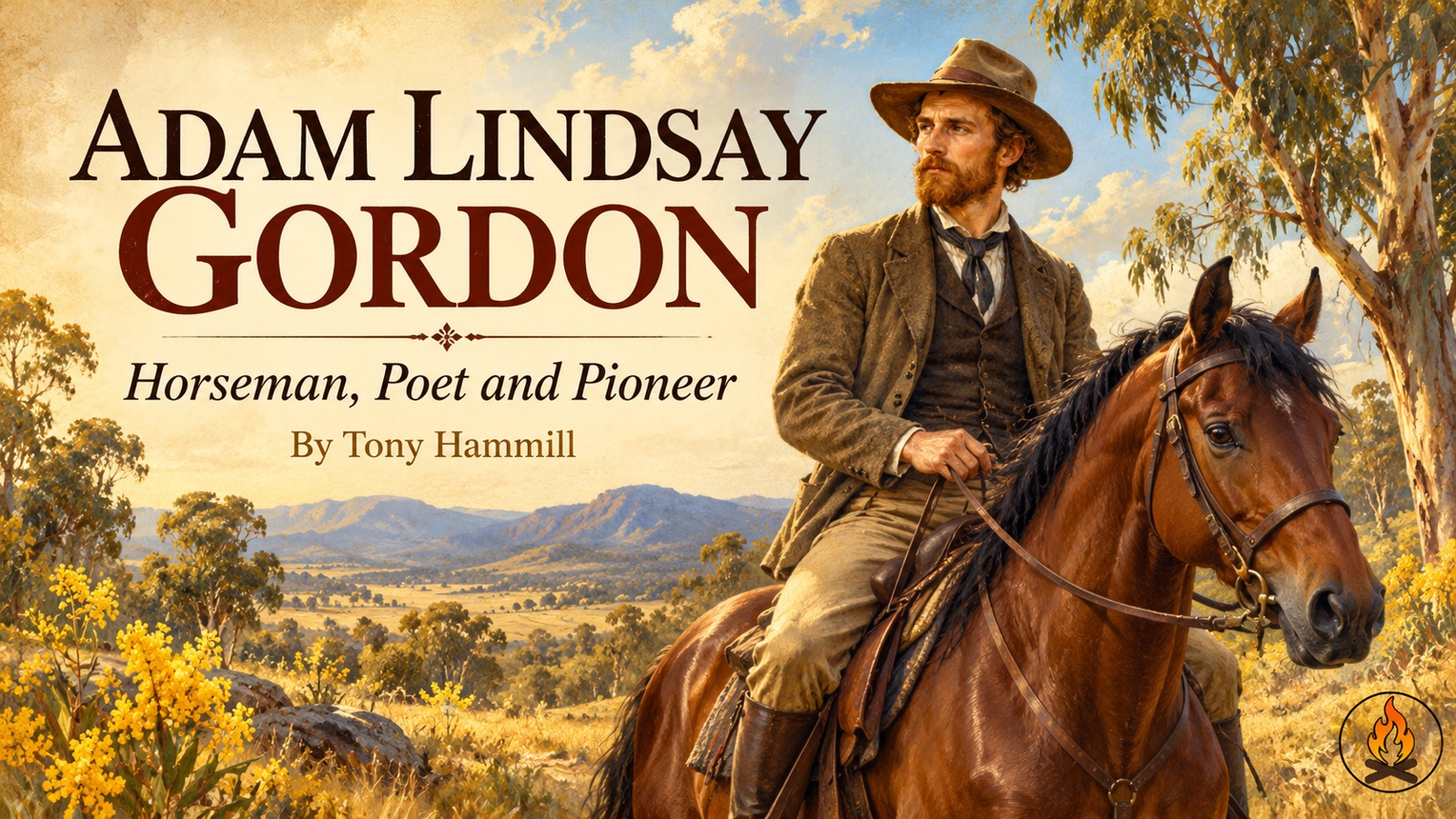
Researched by Tony Hammill
19 October 1833 – 24 June 1870
Adam Lindsay Gordon (1833-1870) was born in the Azores and descended from a Scottish laird. The family moved to Madeira and then to Cheltenham in England in 1840. He attended various schools and was dismissed from the Royal Military Academy at Woolwich for indiscipline. He began to lead a wild and reckless life, contracted debts, and was sent by his father in 1853 to join the South Australian Mounted police. On the day he left he declared his love for Jane Bridges, aged 17, but she rejected his pleading and offer to stay.

Gordon served at Mount Gambier and Penola, and performed the riding feat known as Gordon’s Leap at the Blue Lake, probably on 28 July 1864. There are two contradictory versions of the feat. Mrs Gordon, who was not on the ride, was later to claim the following:
‘On their way back, she said, he put his horse at a high wooden fence, landing on a narrow strip of ground on the steep drop to the Blue Lake two hundred feet below. Then he jumped his horse back again on to the road. This was considered an almost impossible jump, and nobody followed him’.
However, many years later, N.A. Lord, who was present, wrote:
‘..a hunt party was made up, and a large number of us went out after kangaroos. Coming back at about five o’clock in the afternoon, Gordon, Learmonth and myself were a long way in front of the others. Gordon and Learmonth were riding the same horses that they rode in the steeplechase (the previous day). Just before we reached the cutting by the lake, we passed the dry crater of the Devil’s Punchbowl, and without saying a word, Learmonth wheeled his horse off and sent it clambering down the almost perpendicular sides. He rode it back again, but however he did it I do not know.’
‘Learmonth turned to Gordon in triumph and remarked: “There, Gordon, that licks you’’.
‘Gordon said nothing, but continued to ride on until he reached the post-and-rail fence which protected the cutting from the Blue Lake, then went down the bank for a certain distance, and turned and rushed his horse up to the fence and jumped clean onto the road. That was the celebrated leap. He leaped from the banks of the lake into the road, and in coming over the animal fairly wriggled in the air. It was the prettiest jump I have ever seen in my life’. A cairn marks the spot where the jump took place.
Gordon earned a reputation for horse breaking and being handy with his fists, though he gave up drinking for his health. He resigned from the Mounted Police in 1855 and undertook a variety of jobs: horse-breaking, member of parliament, and managing a livery stable in Ballarat. He peppered his largely irrelevant speeches in parliament with Latin quotes, prompting one Hansard reporter to remark that he did not know whether to characterize a speech as Latin with English quotations or English with Latin quotations. He was always something of a misfit in colonial society, and constantly longed for England and home.
Gordon married Margaret Park in 1862 and for a time they lived in a cottage, ‘Dingley Dell’, near Port MacDonnell in South Australia, which is a museum today. They had a daughter Annie who died when ten months old. The cottage they lived in at Ballarat was later moved to the Ballarat Botanical Gardens and can be visited today. In 1868 they moved to Lewis St, Brighton, Melbourne, where he joined the Yorick Club and was befriended by poets Henry Kendall and George Gordon McCrae.
Gordon’s passion was horse-racing (hurdles and steeplechase) and poetry, the former involving him in heavy falls which injured his head and spine and caused constant pain and headaches. On Saturday, 10 October 1868, he rode three winners in the afternoon at Flemington. His business ventures ended in failure, and his debts mounted. He tried to prove that he was heir to the estate of Esslemont in Scotland but failed. He had three books of verse published: ‘Ashtaroth’, ‘Sea Spray and Smoke Drift’ (both June 1867), but on the morning of publication of the third, ‘Bush Ballads and Galloping Rhymes’ (1870), unable to pay the printing costs, he committed suicide with his service rifle at Brighton Beach. He was buried in the Brighton General Cemetery.

Gordon was over 6 feet tall with reddish hair and beard, handsome, shy, sensitive, short-sighted, stooped, irascible, eccentric and moody (the perfect poet?). Geoffrey Dutton, author of ‘Adam Lindsay Gordon’ believed that today he would be diagnosed as bipolar (manic-depressive), since he endured long periods of melancholy followed by short bursts of euphoria, but to what extent this was caused by his numerous head injuries we cannot know. He rode recklessly, as if he had a death wish, which is quite possible, and self-recrimination features in his verse. As bush poet Will Ogilvie wrote:
‘Wild, fearless horseman! With a reckless rein
Riding at Fate’s big fences unafraid.
Holding the Phantom Rider in disdain
And fretting only for his call delayed.’
Gordon was essentially an English romantic poet like Browning, Byron, Tennyson and Swinburne and really didn’t fit into colonial society. Only 11 poems of his are ‘Australian’ in theme and the rest do not make very enjoyable reading, melancholy dominating many of them. ‘Ashtaroth’ was a mediaeval dramatic lyric and practically unsaleable, which I have, ‘Sea Spray and Smoke Drift’ reveals the first glimmers of quality bush verse, and ‘Bush Ballads and Galloping Rhymes’ was a notable achievement which created a new sub-genre: the literary bush ballad.
The bush ballads up to Gordon’s time were rough – rough rhymes for tough times – and generally not to be indulged in by educated folk. Convict Frank MacNamara (‘Frank the Poet’ c. 1810-1861), was one exception with his powerful Moreton Bay poem, the anonymous ‘The Wild Colonial Boy’ another, and Jack Moses (1861-1945) later struck a humorous note with his ‘Nine Miles From Gundagai’.
Gordon invented neither the ballad nor the bush ballad. What he did was to take and elevate the humble bush ballad to literary status, thereby spawning a whole generation of poets dedicated to the sub-genre, reaching its pinnacle in the works of Banjo Paterson. In the process he won the affection of a country that saw itself celebrated in respectable verse for the first time in poems such as ‘From The Wreck’ (though, as Judith Wright pointed out, modelled on Browning’s ‘How They Brought The Good News From Ghent To Aix’) and the iconic ‘The Sick Stockrider.’ This landmark poem was written at Yallum Park Estate, Penola, the home of John Riddoch, fellow parliamentarian, pastoralist and founder of the Coonawarra fruit colony. I believe the tree in the fork of which he wrote it while on holiday is still flourishing.
Will Ogilvie in his poetic tribute wrote:
‘Our Lindsay Gordon! From the northmost cape
South to the Otway he is loved and known;
The boughs that shadow and the dusts that drape
His horse and horseman - are they not our own?
And every bronzed burnt bushman in the East,
And every digger in the Western mines
From him has learned one lilting page at least
And loved it for the heart between the lines.’
It was Gordon’s verse that largely contributed to Will Ogilvie’s decision to become a ‘colonial experience man’, adapting the rich heritage of the Scottish border ballads in which he was already deeply imbued (he nicknamed himself ‘Glenrowan’ and ‘Lochinvar’ after heroes of those ballads) to this country. And Banjo Paterson in developing his own individual style wrote that he had to be careful not to sound like Gordon.
Gordon was once hailed as Australia’s National Poet, but he has long since lost that title. A bust of him stands in Poets’ Corner, Westminster Abbey, and the Queen in her Christmas message of 1992 quoted him (‘Kindness in another’s trouble/ Courage in our own.’) without acknowledgement. Judith Wright wrote that his influence far outweighed his achievement, but a handful of ballads that were Australian in essence, particularly ‘The Sick Stockrider’, created a whole literary movement, and that is achievement enough.

As a person heavily influenced from childhood by a father who loved reciting Gordon, Paterson and Lawson, I will conclude by quoting a few of Gordon’s most memorable lines. From ‘The Sick Stockrider’:
‘Ah! Those days and nights we squandered at the Logans’ in the glen-
The Logans, man and wife, have long been dead
Elsie’s tallest girl seems taller than your little Elsie then;
And Ethel is a woman grown and wed.
I’ve had my share of pastime, and I’ve done my share of toil,
And life is short – the longest life a span;
I care not now to tarry for the corn or for the oil,
Or for the wine that maketh glad the heart of man.
For good undone and gifts misspent and resolutions vain,
‘Tis rather late to trouble. This I know –
I should live the same life over if I had to live again;
And the chances are I go where most men go’.
‘Let me slumber in the hollow where the wattle blossoms wave,
With never stone or rail to fence my bed;
Should the sturdy station children pull the bush flowers on my grave,
I may chance to hear them romping overhead.’
And from Fytte 8 of ‘Ye Wearie Wayfarer’ emerge the exquisite, dreamlike lines obviously written on a creative high:
‘Hark! the bells on distant cattle
Waft across the range,
Through the golden-tufted wattle,
Music low and strange;
Like the marriage peal of fairies
Comes the tinkling sound,
Or like chimes of sweet St Mary’s
On far English ground.
How my courser champs the snaffle,
And with nostril spread,
Snorts and scarcely seems to ruffle
Fern leaves with his tread;
Cool and pleasant on his haunches
Blows the evening breeze,
Through the overhanging branches
Of the wattle trees:
Onward! To the Southern Ocean,
Glides the breath of Spring,
Onward, with a dreamy motion,
I, too, glide and sing –
Forward! Forward! still we wander –
Tinted hills that lie
In the red horizon yonder –
Is the goal so nigh?
Whisper, spring-wind, softly singing,
Whisper in my ear;
Respite and nepenthe bringing,
Can the goal be near?
Laden with the dew of vespers,
From the fragrant sky,
In my ear the wind that whispers
Seems to make reply –
‘Question not, but live and labour
Till yon goal be won,
Helping every feeble neighbour,
Seeking help from none;
Life is mostly froth and bubble,
Two things stand like stone:
KINDNESS in another’s trouble.
COURAGE in your own.’
Courage, comrades, this is certain,
All is for the best –
There are lights behind the curtain –
Gentles let us rest.
As the smoke-rack veers to seaward
From ‘the ancient clay’, (ie pipe)
With its moral drifting leeward,
Ends the wanderer’s lay.
As the pioneer of our rich heritage of literary bush verse, the poetry of the people, Gordon is owed much by Australia, and especially by we who honour and practise his craft.

Source: Tony Hammill’s article “Adam Lindsay Gordon — Bush Poetry’s Pioneer”, eMuse, Vol. 10 No. 2, February 2021, pp. 26–28. Historical images reproduced from the supplied issue.

Tony Hammill
Award-Winning Bush Poet • Australian History Writer • Researcher • Retired Teacher
Tony Hammill is an award-winning bush poet and Australian history writer whose research explores folklore, historical figures and the stories behind Australian legends.