
Researched by Tony Hammill
Eulo is a town of around 100 inhabitants situated on the banks of the Paroo River in south-west Queensland 64 km west of Cunnamulla. Its foundation and growth was destined to be. It was built on the banks of one of the best waterholes on the Paroo along a stock route, and no doubt started with a shanty and store for thirsty, hungry drovers. By 1888 it boasted a post office, police station, a Court of Petty Sessions, a telegraph office, and a state school.
Eulo became a changeover station for Cobb & Co travellers on the route between Cunnamulla and Thargomindah, and was a junction for travellers heading north from Hungerford to either of those towns. Weary travellers would have their needs met at the town’s hotels. The discovery in 1883 of the Yowah Opal Mining Field 150 km north-west of Cunnamulla brought hordes of miners into the district. Visitors to Eulo were therefore drovers, stockmen, station workers, squatters, opal miners and travellers.
Today Eulo is a laidback town with many attractions for tourists. These include the annual Music in the Mulga festival on Wandilla Station, the World Championship Lizard Races, local art exhibitions, the rich local Yapunyah honey (beekeepers from down south visit the region every winter so their bees can feed on the local eucalypt blossoms), spring carpets of wildflowers, artesian mud baths, a date farm and winery, and two businesses whose names honour the town’s legendary identity: the Eulo Queen Opal Centre and The Eulo Queen Hotel. Today, thanks to online resources like trove, ancestry and the national archives, we’re able to fill in details of The Eulo Queen’s life previously in doubt.

Isabella (Isabel) Richardson/McIntosh/Robinson/Gray was born in London in 1850. That is stated on her first marriage certificate and backed up by family trees on ancestry. On her second marriage certificate she claimed to have been born on Mauritius, possibly to conceal her real identity. Her parents were James Richardson, a captain in the Grenadier Guards, and Priscilla Wright.
Isabella was well-educated, spoke fluent French and German, and talked of childhood years in Paris. She arrived in Australia as a teen around 1868, and worked as a governess on a station near Bourke. In April 1869 she married a Scot named John McIntosh at Warialda in NSW and claimed that he died soon after. In March 1871 at Roma she married Richard William Robinson (1839-1902), station manager of Spring Grove, Surat. She listed herself as a widow and governess.
Isabel’s extraordinary career had begun. In later years she claimed that she was not a widow at the time of her marriage to Robinson, and that her final husband, Herbert Victor Gray (1880-1917), who she married in1903 after Robinson’s death in 1902, had a wife and family living in Tasmania when she married him. Both claims can be confirmed. Family trees on ancestry reveal that the John McIntosh (born 1836) who married Isabella Richardson, died at St George in 1903 aged 67.It is quite possible that she threw McIntosh over for the better prospect in Robinson; and marriage records show Herbert Victor Gray, aged 19, married Maud Charlton in 1899 at Launceston, Tasmania. Bigamous relationships were not a problem for Isabel.
Robinson became station manager for Cobb & Co at Cunnamulla and in the mid-1870’s manager of the company’s change –station at Eulo. Realising opportunity when they saw it, they built a shanty with mud from the Paroo River and later obtained a hotel licence, naming it The Royal Mail Hotel. Eventually they owned three hotels –the Royal Mail, the Empire and the Metropolitan – a store and a butcher’s shop.
Around this time the reign of The Eulo Queen began. Accounts differ, but it seems she was a smallish woman with flawless skin, fine-boned, vivacious and of considerable beauty. One account has her hair light brown and her eyes gray, another as having dark hair and eyes. She was a raconteur and a charmer, and men quickly fell under her spell. She could ride a horse or drive a four-in-hand as well as any man, and was a crack shot.
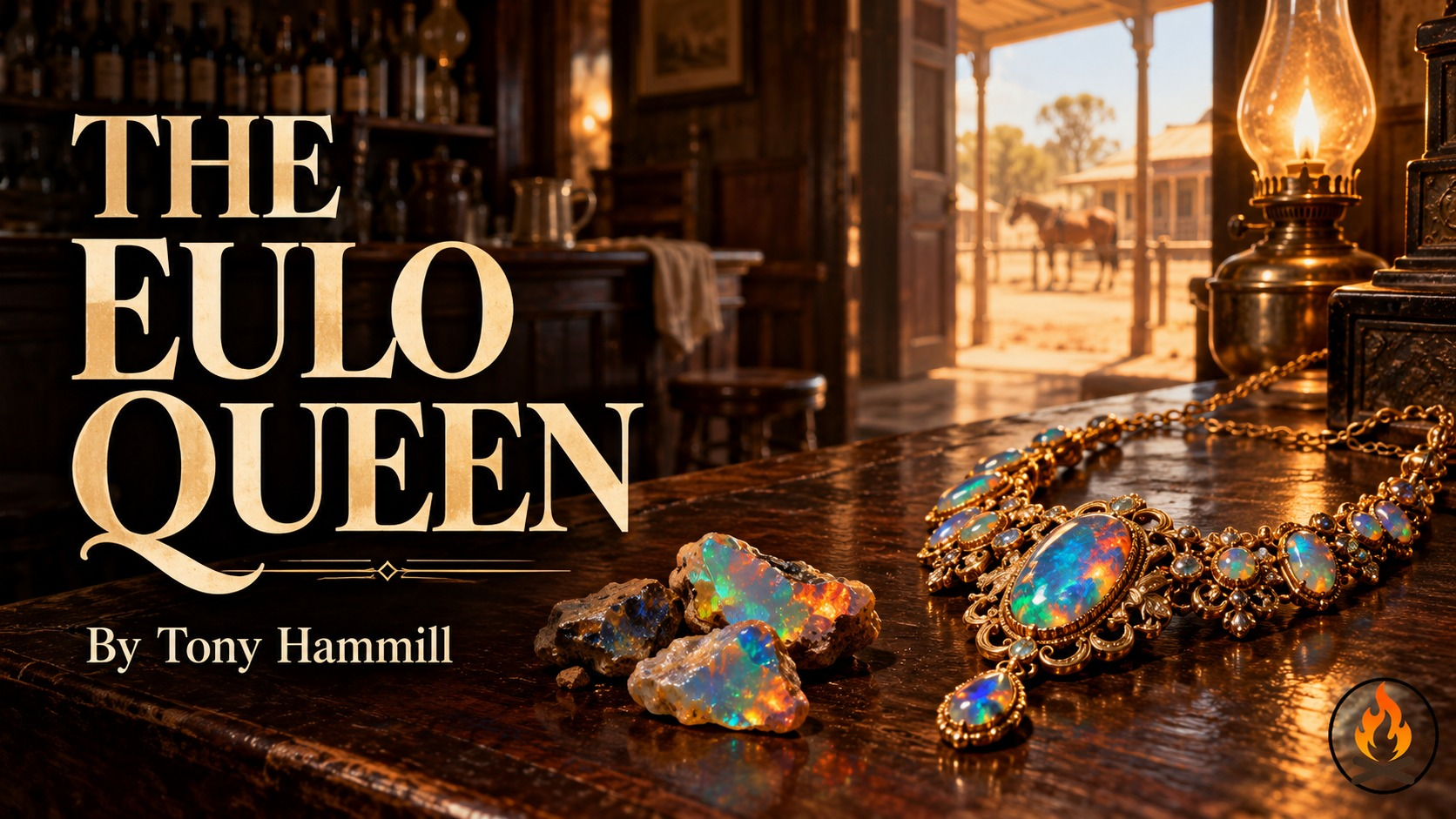
Isabel dressed in finery, traded rum and stores with the opal miners to amass a fortune in opals, and adorned herself with opal necklaces and a belt studded with them. She turned the Royal Mail into a brothel with many bedrooms staffed by local aboriginal beauties, and entertained the local ‘silvertails’ after hours in the lavishly furnished ‘Stateroom,’ with rigged gaming machines, card games, a snooker table, and a supply of sly grog. She also kept fast horses, employing an ex-jockey to race them for wagers against all comers who fancied their mokes. During the 1880’s she was in her heyday.
The story of how she earned her title may be apocryphal, but it is said that once when she ordered a stockman out of her bar, he angrily responded with, “Who do you think you are?” and received the reply, “I’m the Queen of Eulo. Now get out!” Given her dress and status in the town, however, that title would have been inevitable.
Isabel was a hard-headed businesswoman but had a reputation for erratic generosity, and would often help those down on their luck. J.H. Heathcote wrote, “Probably there are many bushmen today who gratefully remember when as ‘lame dogs’ they were helped by the Paroo or Eulo Queen.” However, another said, “She’d take a man’s last dinar and then turn him out in a dust storm!” It is claimed she ruthlessly exploited workers.
Isabel quickly became a genuine bush legend known throughout Queensland and New South Wales, and men simply had to visit her establishment when in the district. There was a saying that ‘If strangers had seen Jackie Howe the big-gun shearer, the Great Whampoo (a ship’s stoker with many stories), and the Queen of Eulo, they knew the back country.’
For the rough bushmen starved of female company, this stylishly dressed, attractive, voluptuous, articulate woman in her forties with the dazzling smile was a wonder to behold in their spartan world. But as one station hand wryly commented, “Ordinary stockmen and bullockies never got a look-in with the Eulo Queen. You had to be a squatter or an opal-gouger who had struck it rich for that!” She would quiz and ‘weigh-up’ everyone she met, and counsel young tearaways in a motherly way.
‘Bill Bowyang’ in Gentlemen! The Queen celebrated her in verse:
“She knew every teamster and hawker’s van,
Every man with a miner’s right;
And she was the mistress of every man
As he dreamt in his swag at night.
She won their hearts and she took their pelf,
Was it love in her eyes they read?
Yes, each one believed it would be himself
She’d love, had she not been wed.”
Breaker Morant, who worked around Cunnamulla in the early nineties, wrote of her in For Southern Markets with the lines:
“We came through Eulo township and camped to see ‘the Queen’
(As every drover man has done who has through Eulo been!)”
We are fortunate in that men who met her in her prime, and later in her declining years, left a record of their encounters. ‘Murrawombie’ got to know her over a six week period, probably in 1891, and stayed part or all of that time at the Royal Mail. He says:
“I stepped into the sanctum sanctorum, or the throne-room of the Eulo Queen…into the gloriously furnished room. The Eulo Queen greeted me from her low, easy chair, and begged me to be seated, and to make myself at home.
Was she beautiful? She was dazzling, her somewhat short, dark wavy hair fringed, with a beautiful forehead and dark lustrous eyes. She seemed to size me up as she held her gold pince-nez in her heavily bejewelled hand, and I knew she knew I was lost in admiration for the beautiful ‘fermoy’ opal necklace that was linked with gold about her neck.
Her frock was decoilete, very much so, perhaps to make more space for those massive opals that glinted green fire, and big enough to grill a chop on. Her frock was decoilete from the other end as well, and her court shoes just missed covering an ankle, like the pasterns of a well-bred race horse.”
But the law was eventually to catch up with the Robinsons. In January 1890 The Telegraph reported: ‘At the Eulo Police Court today, Isabella Robinson, well known in this district as ‘‘The Queen,” was fined 10 pounds and costs for sly grog selling. She was also called upon to show cause against the confiscation of liquor to the value of 100 pounds found upon her premises.’ The evidence was that ‘the liquor was kept for illegal sale, and was sold for defendant’s sole benefit in a private bar in one of the bedrooms of the Royal Mail Hotel. The evidence also showed that very great immorality was practised at the hotel.’ The liquor was confiscated, but the bed and bawd continued.
In April 1892 the police objected in court to the renewal of Richard Robinson’s licence ‘on the ground that immorality was practised on the premises.’ The renewal was refused. In September 1892 the police seized two tons of liquor consigned to Mrs Robinson. It arrived by railway, and was being carted along the Cunnamulla road when seized. Mrs Robinson’s application for a licence had been refused by the Eulo bench some months previously. Isabel shrewdly circumvented this rejection by setting up ‘dummies’ who would hold the licences for her, and the Queen continued to reign! At some point Richard returned to Cunnamulla to run Cobb & Co’s store there, leaving Isabel to take care of business. She did.

Isabel made and lost fortunes in the nineties. She lost money in the 1893 financial crisis and the 1896 failure of the Queensland National Bank. She was licensee of The Carlton Club Hotel in Queen St Brisbane for a time, but lost much of her investment and sold it around 1897. Other investments failed, and she sold her fabulous opal collection to pay her debts.
In 1902 Richard Robinson died, and in 1903 Isabel married her storeman, Herbert Victor Gray (already married, as stated earlier). He was 23 and she 53, though she recorded her age as 35 and he as 29.Theirs was a stormy relationship, and she later described him as ‘a bad lot, a thoroughly bad lot.’ She had him charged with stealing a cooked fowl that was intended for a magistrate’s lunch, and he served three months’ jail. In 1913 she toured Europe with a wealthy squatter, and when she returned she quarrelled with Gray who beat her. He was convicted of assault and fined 25 pounds. Electoral records show that in 1905 he resided in Eulo, then at St George as a labourer, back to Eulo, then Cunnamulla, Roma and finally Mitchell in 1915, his occupation given as cook.
Herbert Victor Gray enlisted in Mitchell in November 1916 as 7251 Hector Victor Gray, 9 Bn AIF, cook, born Canterbury, New Zealand, the ‘Hector’ possibly to throw pursuers off the scent. He embarked for France in January 1917, but was returned to Australia from Capetown in May 1917 suffering from phthisis pulmonalis, a tuberculosis of the lungs with progressive wasting of the body. He was discharged on 5 July 1917, and died under his enlistment name in Mitchell on 3 December 1917. Isabel received a military pension, but only after proving that Hector and Herbert Gray were one and the same person. She stated that “..the only decent thing he ever did was to die in camp (sic) and leave me a small army pension of 25 shillings a week.”
The fall of The Eulo Queen began with the onset of World War 1. A recession occurred in the opal industry, and many men never returned from the war for various reasons. She was arrested again in 1916 for sly grog selling, and slashed her abdomen with a razor during an adjournment of the court hearing. At least one, and possibly two of her hotels were burnt down, and she sold the third. By 1926 she was living in the squalid remains of her old store by the Paroo wearing a coarse black shirt and a rough hessian dress. She told a visitor in her refined voice:
“There are no people round here that I like, and they are always causing trouble, so I keep clear of them. Sometimes I take a little walk up to the settlement, and occasionally I have a meal at the hotel. But mostly I read. My memory is still good, and so I think of the past. There were days when I was a power around here. But I made enemies, and they were determined to break me. When they couldn’t break me any other way my hotel was burned down, and my store was broken into and robbed, and what with one misfortune and another, here I am.”
Isabel Gray died at the Baillie Henderson Hospital in Toowoomba on 7 August 1929. Buried in the Drayton and Toowoomba cemetery in a pauper’s grave, she left an estate of 30 pounds. So ended the life of probably Queensland’s most colourful character, but the legend will never die. And so we join in the toast so often given at Isobel’s hotels, Long live the Queen!

Tony Hammill
Award-Winning Bush Poet • Australian History Writer • Researcher • Retired Teacher
Tony Hammill is an award-winning bush poet and Australian history writer whose research explores folklore, historical figures and the stories behind Australian legends.