Some camps are not found on the main road.
They are the ones you come across by taking the quieter track, following the gravel, crossing the creeks and seeing what turns up.
For Gary & Christine, Hughes Crossing on the Mitchell River, west of Chillagoe in Far North Queensland, was one of those places.
Shared as part of The Campground Project, this campground yarn comes from Gary’s July 2026 stay beside the Mitchell River while travelling with a caravan, his partner and two dogs.
Quick Campfire Notes
Campground: Hughes Crossing, Mitchell River
Location: Burke Developmental Road, west of Chillagoe, Queensland
Visited: July 2026
Cost: Free
Setup: Caravan
Travelling with: Couple with two dogs
Best for: Self-sufficient campers, off-road caravans, 4WD travellers and those who enjoy quiet riverside camps
Facilities: Basic bush camp / no facilities
Fires: Allowed when visited
Dogs: Dog-friendly when visited
Access: 4WD recommended, off-road caravans and campers only
Would they go back? Yes
A hidden spot on the Mitchell River
Gary said they always prefer taking the road less travelled to find the hidden gems most travellers never get to see.
Hughes Crossing was one of those gems.
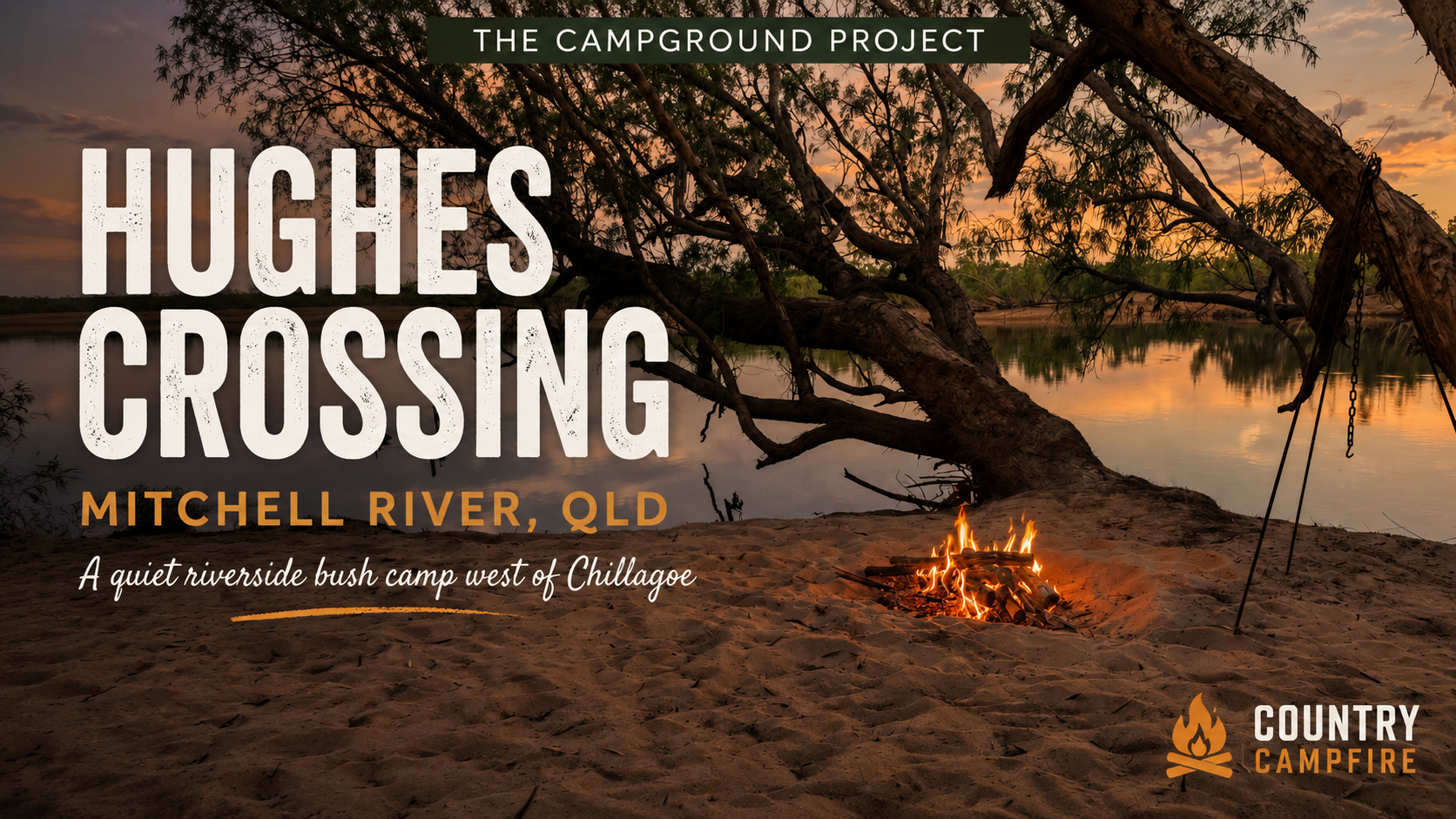
When they arrived at the crossing, they were lucky enough to get the spot right on the water’s edge, tucked into the shade of magnificent paperbark trees.
There is only room for one van at the riverfront spot, so it is not the sort of place where you can count on pulling in and finding space beside the water. But when it is available, it sounds like a beautiful little camp.
The ground at the riverside site is fine river sand, but Gary said it was not too soft. The run in from the gravel track is only short, which makes the camp easy enough once you are in the area and set up for that sort of travel.
If the riverfront spot is already taken, Gary said there is a much larger clearing about a hundred metres back from the water, suitable for caravans and able to accommodate quite a few vans or campers.
What makes it special
The main drawcard here is the setting.
Gary described it as quiet, peaceful and right on the water. While a few travellers pass through during the day, it is not a busy campground.
For those who like remote camps, river country and a bit of space, that is a big part of the appeal.
There is access to fresh water for washing and camp use, and the spot may also suit anyone keen on fishing. Gary mentioned barra fishing, although he had not had any luck at the time of sharing his notes.
The camp was also dog-friendly when Gary stayed, which is always useful for travellers moving through with four-legged mates.
Crocodile country
This part is important.
Gary noted that swimming is not advised at Hughes Crossing, as this location is considered crocodile country.
That means care should be taken at all times near the water, even if the camp itself looks peaceful and inviting.
The Mitchell River might make a beautiful backdrop for camp, but this is not the place to be casual around the water’s edge.
Getting there
Hughes Crossing sits along the Burke Developmental Road, west of Chillagoe.
Gary described the road as a classic Gulf and Savannah station road. For him, the journey in was part of what made the camp and this part of Australia so enjoyable.
The unsealed road was in decent condition when they travelled it in July 2026, but it is still remote country, with numerous single-lane water crossings typical of the area.
Gary recommends a 4WD and says the camp is best suited to off-road caravans or campers.
The road is dry-season access only.
Wildlife on the way
The drive in was not just about the road.
Gary said wildlife was plentiful along the way, with brolgas, jabiru, perentie and the usual kangaroos getting about.
That sort of detail is part of why campground yarns matter. Sometimes the road into camp is as memorable as the camp itself.
Facilities
Hughes Crossing is a basic bush camp with no facilities.
That means campers need to be fully self-sufficient and prepared to take everything in and everything out.
There are no toilets, showers, bins, water taps or powered sites listed in Gary’s notes.
This is the kind of camp for people who are set up for remote travel and comfortable leaving no trace.
Would Gary go back?
Yes.
Gary said they would definitely come back to this camp spot.
For travellers who enjoy quiet places, river country, remote roads, paperbark shade and a proper off-the-beaten-track feel, Hughes Crossing sounds like the sort of camp that stays in the memory.
Photos from the camp


Thanks to Gary Barten
Gary Barten is a long-time traveller exploring Australia by caravan with Christine and their two dogs.
Gary prefers the road less travelled and has a good eye for quiet bush camps, remote tracks and the sort of places many travellers drive straight past.
Gary’s Hughes Crossing yarn helped kick off The Campground Project, Country Campfire’s mission to collect real campground stories, photos and practical notes from people who’ve actually camped there.
See Gary on:
Part of The Campground Project
This campground yarn is part of The Campground Project — Country Campfire’s mission to collect real campground yarns, photos and practical notes from people who’ve actually camped there.
If you’ve stayed somewhere worth sharing, you can send your own campground yarn through The Campground Project form:
https://countrycampfire.com.au/campground/
Every campground has a story. Sometimes it starts with a river crossing, a patch of shade and a quiet spot beside the water.
A quick note before you travel
Campground access, road conditions, fire rules, dog rules, fees and facilities can change.
These notes are based on Gary’s visit in July 2026 and should not replace current official information.
Always check current road conditions, local advice, fire restrictions and relevant land manager information before heading off, especially in remote areas and crocodile country.
That’s the heart of The Campground Project — real campers sharing real places, one campground yarn at a time.