
Spring has finally turned up — and country Australia is wasting
no time getting moving.
G’day Campfire Nation,
If you are reading this over a Father’s Day breakfast, hopefully the
coffee is hot, the socks fit and nobody has handed Dad a list of jobs
before he has finished either one.
September feels like the month the country starts moving again. The
days stretch out. The wattle comes alive. Sheds, showgrounds and
racetracks begin filling up, and weekends that looked empty through
winter suddenly need a decision.
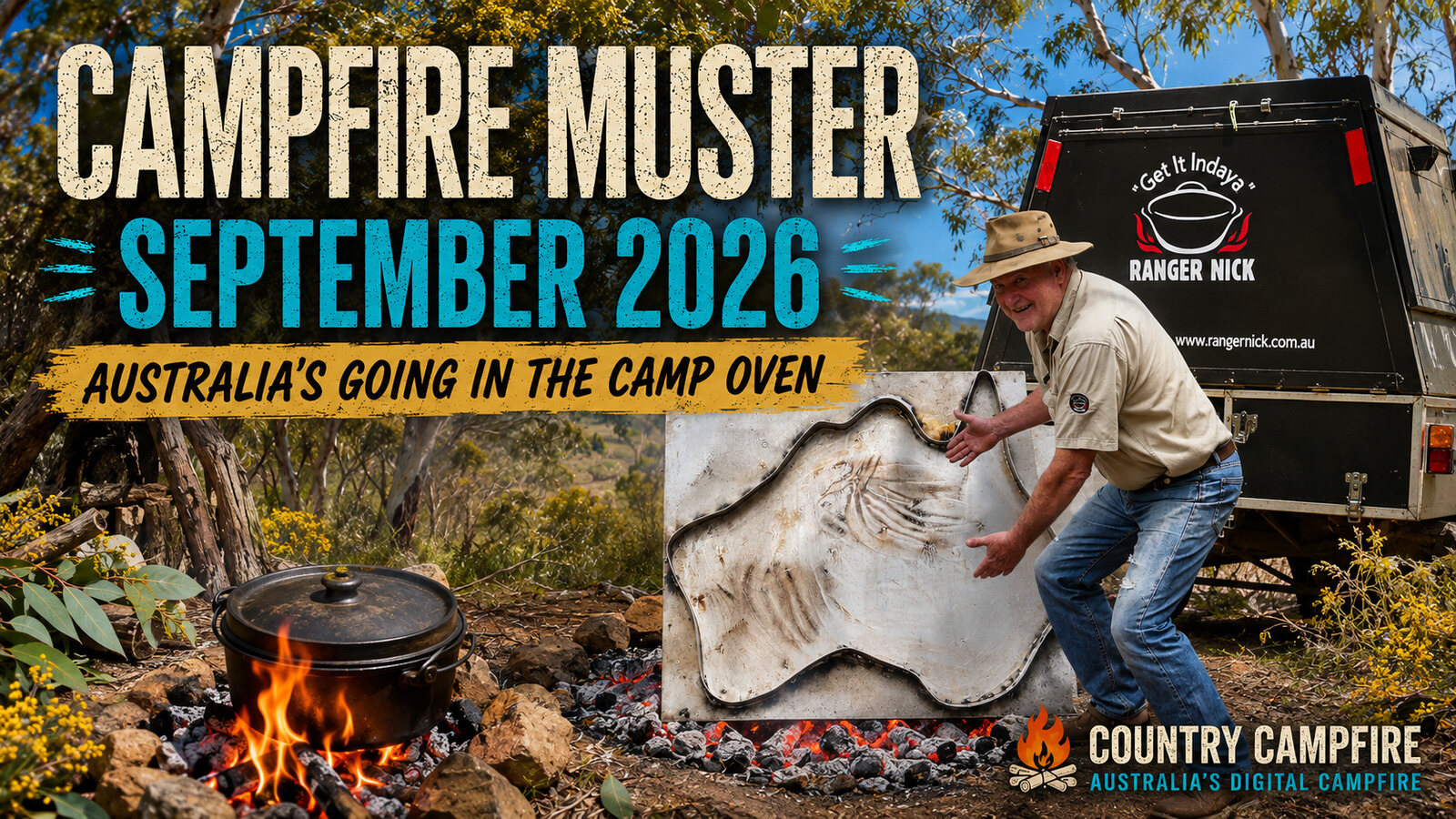
This month, one of those decisions may involve watching a Queensland
bush cook attempt to turn the entire map of Australia into lunch.
There are also four very different ways to spend the October long
weekend, a mob of swimming emus, five-metre UGG boots, new Australian
country voices, a photographer who keeps putting the outback in front of
hundreds of thousands of people, and an anniversary that still has the
power to stop Australians in their tracks.
Pull up a stump. Spring has finally given us something to talk
about.
Someone Is About to Cook
Australia
On Saturday 3 October, Ranger Nick will stand beside an
Australia-shaped cooking plate at the Australian Camp Oven Festival in
Millmerran and attempt something wonderfully unreasonable.
He plans to make the largest meatloaf in the shape of Australia —
cooked over hot coals.
This will not be a small meatloaf that happens to look a bit like
Tasmania if you squint. The preparation, cooking and measuring will be
filmed as evidence for the Australian Book of Records, with community
witnesses overseeing the attempt and signing the official paperwork.
And if he pulls it off, the crowd gets to eat the evidence.
It is exactly the kind of idea Country Campfire exists to find: part
bush skill, part spectacle, part country humour and completely
impossible to explain without making somebody ask a follow-up
question.
Nick is not new to cooking on an ambitious scale. He was part of the
Australian team behind the 153.002-metre damper that earned a Guinness
World Records title in Charleville in 2019. He has spent years taking
camp oven cooking, bush knowledge, stories and poetry to festivals
around the country.
But even for Ranger Nick, cooking the mainland is a step up.
The attempt will be one of the headline moments at the Australian
Camp Oven Festival, held at the Millmerran Showgrounds on 3 and 4
October. The rest of the weekend brings camp oven competitions, bush
poetry, heritage displays, demonstrations, music and enough food smoke
to make arriving hungry feel like sound planning.
Whether the day ends with an Australian record, a very large feed or
an unfortunate collapse somewhere around the Great Australian Bight, it
should be worth seeing.
Plan your Australian Camp Oven
Festival weekend
Know somebody who takes camp oven cooking very seriously? This
may be the story to send them.

The October
Long Weekend Is Closer Than It Looks
The first weekend in October is one of the big travelling weekends of
the year. By the time the October Muster arrives, it will be over — so
this is the one that matters if you still need tickets, camping or a
believable answer from the mate who keeps saying, “Yeah, I should be
right.”
The good news is that four completely different versions of country
Australia are happening on the same weekend.
If your country weekend needs several thousand utes
The Deni Ute Muster returns to Deniliquin on Friday
2 and Saturday 3 October.
Deni is no longer merely an event with a ute competition attached. It
has become one of the annual pilgrimages of Australian ute culture — two
days of music, bull riding, woodchopping, driving events, camping and
machinery decorated with everything from careful pride to decisions best
understood after midnight.
Camping opens Thursday morning and closes Sunday. If Deni is your
choice, this is the moment to stop talking about it and actually
organise it.
Deni Ute Muster
information and tickets
If you want to watch the old working country come alive
At Barellan in the Riverina, the Good Old Days
Festival runs from 2 to 4 October.
This is not history behind glass. Clydesdales, bullocks, camels,
donkeys, mules and goats return to harness. There is blade shearing,
whip cracking, camp oven cooking, old trades and the sight of skills
that once kept the country moving being performed by people who still
know how to do them.
Last year more than 10,000 people watched 62 heavy horses form a
single team and pull a six-tonne load of wool. It took years of
breeding, training and planning to create a line of horses stretching 76
metres across the arena.
Barellan is one of those festivals where nostalgia becomes something
more useful than looking backwards. Old knowledge gets practised,
younger people see it done properly and a small Riverina town fills with
people who understand why it matters.
Explore the Good Old
Days Festival
If horsepower means two different things
The Bend Classic takes over the Shell V-Power
Motorsport Park at Tailem Bend from 2 to 4 October.
Historic touring cars, Formula 5000s, motorcycles, muscle cars and
nostalgia drags share the weekend with camping, country music and a full
rough-stock rodeo. Lee Kernaghan headlines Saturday night, with James
Johnston among the Australian performers joining him.
It is a new combination, but cars, country and camping hardly require
a lengthy sales pitch.
See what is happening at
The Bend Classic
If lunch is the main event
Choose Millmerran, find Ranger Nick and keep an eye on whichever end
of the meatloaf contains Queensland.
Australian Camp Oven Festival
details

Three September
Weekends Worth the Drive
Not everything worth attending needs a huge national lineup or ten
thousand people through the gate. Sometimes the right weekend is simply
the one that keeps a tradition alive, puts money through a country town
and gives everyone a reason to gather again next year.
Nanango still sings
in an Australian voice
The Heritage Nanango Country Muster runs from 10 to
13 September at the Nanango Showgrounds in Queensland’s South
Burnett.
Its focus is traditional Australian country music. That distinction
matters at a time when country music has never been more popular, yet
Australian voices can still struggle to be heard beneath the volume
coming from overseas.
Nanango offers four days for the people who still want the songs to
sound as though they came from somewhere they recognise.
Heritage Nanango Country
Muster
Henty
opens the biggest paddock showroom in the east
The Henty Machinery Field Days return from 22 to 24
September.
Established in 1963, Henty has grown into the largest outdoor
agricultural event in eastern Australia, bringing machinery, livestock,
technology, rural businesses and tens of thousands of people together in
one enormous working display.
Field days are partly about seeing what is new. They are also about
finding the bloke you have not seen since last year, having a
twenty-minute conversation in the middle of a laneway and realising you
have moved approximately six metres since breakfast.
Murrurundi
puts the old stockman’s skills to the test
From 25 to 27 September, the King of the Ranges Stockman’s
Challenge and Bush Festival returns to Murrurundi, NSW.
Competitors are tested across cattle work, packhorse work, bareback
riding, target whip cracking, horseshoeing and cross-country jumping.
Around them, the bush festival adds poetry, yarn spinning, billy
boiling, markets and junior whip-cracking.
It is competition, but it is also recognition: the practical skills
of Australian stockmen and women deserve somewhere they can still be
seen, measured and admired.
King of the Ranges
program and tickets

Ninety Years Without the
Thylacine
The day after this Muster is published marks 90 years since the last
known thylacine died at Hobart’s Beaumaris Zoo.
On 7 September 1936, the animal now remembered as the last Tasmanian
tiger died in captivity. Legal protection for the species had arrived
only 59 days earlier.
Fifty-nine days.
That small number is why the story still lands so heavily. Australia
acted, but only once there was almost nothing left to save.
The thylacine has never really disappeared from the national
imagination. Its striped back still appears across Tasmania. Old
black-and-white footage is watched again and again. Reported sightings
continue to surface because some part of us would rather believe a few
animals slipped away into the bush than accept what happened.
The anniversary became National Threatened Species Day — not only to
remember what was lost, but to pay attention to the species for which
the ending has not yet been written.
Read
the National Museum of Australia’s thylacine history

The thylacine received legal protection for just 59 days. That is
the fact from this Muster worth remembering — and passing on.
Meanwhile, Four Emus
Crossed a River
Australian wildlife rarely lets a serious mood settle for too
long.
A mob of four emus was recently filmed swimming across the Murchison
River near Kalbarri in Western Australia. Their bodies disappeared below
the surface while four long necks and heads bobbed steadily towards the
opposite bank.
The footage passed five million views, presumably because a large
share of the country discovered at the same moment that emus can
swim.
They can. Quite well, apparently.
Known for running at around 50 kilometres an hour, emus will also
take to the water when they need to cross a river or reach food. Seen
from a distance, however, they look less like birds and more like four
suspicious feathered periscopes.
Watch
the swimming emus cross the Murchison
Send that one to somebody who reckons they already know everything
strange about Australian animals.
The Bull Worth More Than Most Houses
At a spring bull sale near Bathurst, an Angus bull named Millah Murrah Wyatt W50 walked into the ring and left carrying a price tag of $420,000.
That made him the most expensive bull ever sold in Australia — and the most expensive beef animal of any kind ever traded here.
Wyatt was 19 months old and weighed 834 kilograms at the time of sale. But buyers were not merely paying for one particularly impressive black bull. They were buying access to genetics combining calving ease, weight gain, carcase performance and pedigree, with interest in his semen already coming from Australia, Canada and the United States.
The breeder believes Wyatt’s semen could eventually generate revenue in the seven figures. In other words, the $420,000 bull may turn out to be the cheaper part of the story.
There is a human detail behind the record too. Wyatt was named in honour of stud principal Ross Thompson’s late father, making the moment an emotional one for the family behind Millah Murrah Angus.
Some sale prices make sense immediately. Others require you to understand that the real value of a champion bull may be spread across herds—and continents—for years to come.

See the record-breaking bull
ABC Rural has the real photographs of Wyatt W50 and the full story from the sale near Bathurst.
Australia’s
Big Things: The Boots That Survived Their First Storm

At Thornton in the NSW Hunter, a pair of UGG boots stands five metres
tall outside Mortels Sheepskin Factory.
Each fibreglass-and-steel boot is 13 times the size of a women’s size
eight and weighs about 600 kilograms. They were unveiled on 20 April
2015 — and met their first major test almost immediately when wild
weather struck the Hunter the following day.
The boots stayed put.
Mortels has been making sheepskin products since 1958 and describes
itself as the oldest continuously operating UGG boot factory in the
world. Visitors who stop for the obvious photograph can also visit the
Sheep’s Back Museum and see the manufacturing story behind the roadside
landmark.
That is what the best Australian Big Things do. The giant object gets
you off the road. The local story makes the stop worthwhile.

Five Australian
Voices to Put in Your Ears
This is not an attempt to catalogue every song released this month.
These are five Australian artists with a reason to stop and listen.
Brooke McClymont and Adam Eckersley have released
their third album together, Souls on Show. Their voices work
because they do not sand all the rough edges off one another. The songs
still sound lived-in, and a 33-date Australian tour begins in
November.
Katrina Burgoyne is a Gunnedah-born, Nashville-based
Australian who writes country music with humour, nerve and a refreshing
lack of interest in behaving quietly. Her latest single, I Want a
Boy Like You, Cowboy, arrived on 28 August, ahead of an Australian
return with her American Honky Tonk Roadshow later this year.
Riley Ziskey comes from Longreach, works as an auto
electrician and grew up on cattle stations in western Queensland. His
first solo single is called Bore Water Soul. Some titles
require an explanation. That one tells you exactly where the song came
from.
Saralyn, from the Hunter Valley, has released her
debut five-track EP, Goldline. Its title song begins with the
loss of her sister and grows into something larger about heartbreak,
healing and finding a way forward. September and October shows will take
her through Brisbane, Toowoomba, Port Macquarie and Muswellbrook.
Meet Saralyn and hear
Goldline
Michael Honan, from Warrnambool, followed the
success of Hold You Close with Be the Whiskey. He has
already appeared at CMC Rocks, Groundwater and Lasso, but still feels
like an artist plenty of Australian country listeners are about to
discover for the first time.
If one of those voices earns a place in your playlist, pass the name
on. Australian country music grows when Australian listeners become the
recommendation.

Photo of the
Month — and Someone Worth Following
Country Campfire is built on a simple belief: when somebody is doing
good work celebrating Australia, sharing it helps the whole campfire
grow.
This month, both honours belong to Australian Outback
Photography.
Andrew Ramage has built one of the country’s largest social
communities dedicated to regional and remote Australia. More than
160,000 people follow the Facebook page, where photographs of stations,
storms, working country, disappearing towns, old pubs, wildlife and
enormous inland skies reach millions of viewers each month.
The scale is impressive, but the reason to follow is not the number.
It is the steady attention Andrew gives to places most Australians will
never see in person — and to the photographers and stories behind
them.
Our September Photo of the Month comes from the Pilbara — country with a scale, colour and character that rarely needs help making somebody stop mid-scroll.
We have embedded Andrew’s original post below so the photograph, caption and recognition remain exactly where they belong: with Australian Outback Photography.
At its best, Australian Outback Photography does what strong curation
should do: it makes you stop, look properly, learn where the photograph
came from and occasionally send it to somebody with the words, “You’d
love this.”
Follow
Australian Outback Photography on Facebook
Put a Deadline on
the Piece in Your Drawer
Spring is not only bringing events. Several Australian writing
competitions are still open — and sometimes a closing date is exactly
what an unfinished poem or story needs.
The Lambing Flat National Poetry and Writing
Competition closes on 18 September, accepting poems of up to 50
lines and short stories of up to 1,500 words across adult and school
sections.
The Bruce Dawe National Poetry Prize closes on 22
September. The national prize carries $3,000 for the winner and honours
a poet remembered for finding meaning in ordinary Australian lives.
For younger writers, Poem Forest: The Sounds of
Country closes on 25 September. Every eligible poem plants a
tree, turning a young person’s words into something living beyond the
page.
Traditional bush poets have until 9 October to enter the
Silver Quill Written Poetry Competition, while writers
with a country story have until 31 October to enter the
Ernestine Hill Memorial Award for short fiction on an
Australian Country theme.
The poem does not have to feel finished today. It only needs to be
finished before the closing date.
Lambing
Flat competition
Bruce Dawe
National Poetry Prize
Poem
Forest
Australian Bush Poets
Association competitions
Ernestine
Hill Memorial Award
Campfire
Gadget of the Month: A Pump Smaller Than the Problem
Nobody has ever reached the campsite after dark, looked at an
uninflated sleeping mat and thought, “Excellent. I was hoping for one
more job.”
The FLEXTAIL Zero Pump 2 is a rechargeable electric
pump weighing about 48 grams with its battery. It is designed for
sleeping mats and small inflatables, delivering claimed pressure of
3.5kPa from something roughly the size of a finger.
It is not a tyre compressor, and it is not the answer for a
queen-sized air bed that looks like spare furniture. Its appeal is that
it is tiny enough to live in the camping kit until the moment it saves
you blowing up a mattress after a long drive.
At the time of checking, the Amazon Australia listing was about $82.
Price, stock and delivery change — and regional delivery can be
particularly unpredictable — so check that it can actually reach your
postcode before ordering.
Check
the current Amazon Australia price
Affiliate disclosure: Country Campfire may earn a small
commission if you buy through the Amazon link, at no extra cost to you.
The product was chosen before the affiliate link was added.
What Has Been
Happening Around the Campfire
While we have been looking outward for this Muster, the Country
Campfire archive has continued growing underneath it.
Jai Thoolen joined the Country Campfire Legends and brought us into
the Lake Boga Hotel for a beer-pot contest remembered in verse. Geoff
Bagman added the sort of poems that prove bush poetry is allowed to
laugh at itself. Ron Boughton, Peter Pentland and David J Delaney added
more written work to Keeping The Verse Alive, while new podcast and
YouTube releases gave several of those poems a voice as well as a
page.
The Campground Project also crossed into another remote corner of the
country with Gary Barten’s yarn from Negri River Crossing on Duncan
Road.
None of those pieces needs to become breaking news. Their value is
that they now have somewhere permanent to live — and another chance to
find the person who will appreciate them.
One
recent story worth another look: Who really waltzed Matilda?
Before Waltzing Matilda was written, eleven recorded
drownings occurred around Winton. Australian history writer and bush
poet Tony Hammill examined the surviving inquests and found one case
that bears an unsettling resemblance to the song: the 1890 death of
mounted unionist swagman Martin Bourke at Manuka Station.
It is not presented as a solved mystery. It is something better —
careful Australian research that gives an old national story another
layer.
From the archive: a
bend in the Snowy River
Back in April 2024, one of the earliest Country Campfire campground
pieces stopped at Woods Point Campground, about half an
hour west of Orbost in East Gippsland.
The attraction is simple: a long sandy beach on a sweeping bend of
the Snowy River, big established gums and enough room for a proper bush
camp. The final road in is narrow and winding, particularly for larger
caravans, but the destination is the kind of place people tuck away for
warmer weather.
Spring is a good time to give an old campground story another
life.
Missed Last Month’s Muster?
The August Muster followed a 20-year-old publican bringing life back
to a tiny Queensland hotel, visited the Big Trout at Adaminaby and
gathered another month of Australian events, music, poetry and country
stories.
What Are You Passing On?
Maybe your mate needs to know that Australia is about to become a
meatloaf.
Maybe it is the 59 days that came too late for the thylacine, four
emus swimming across the Murchison or a photographer bringing the Pilbara into people’s homes.
Pass that part on.
And if you know an event, photograph, Australian voice, old place or
unusual story that deserves a place in the October Muster, send it through to
Country Campfire.
Until next month,
Country Campfire
Australia’s Digital Campfire
