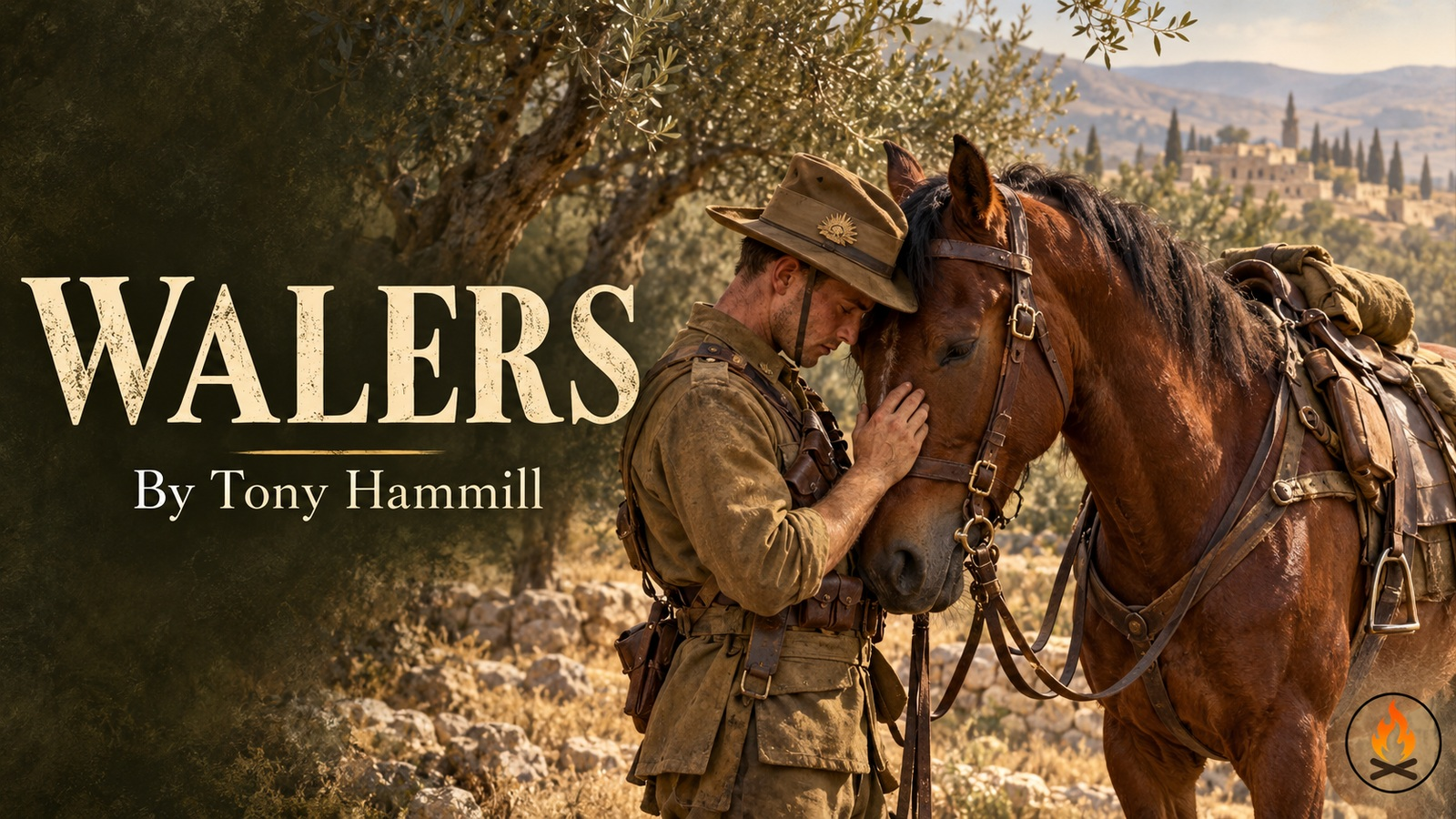
Walers by Tony Hammill honours the horses that carried Australia’s Light Horsemen through the First World War, and the bond forged between horse and rider.
Through an old light-horseman’s memories, Tony takes us from shared water on the Sinai sands to the grief of a final farewell. At its heart is a soldier’s enduring love for the mate who carried him through it all.
Walers
By Tony Hammill
“The Walers!” he sobbed like his heart would break, and turned his head away,
But the old light-horseman told his tale to me at last that day.
………………..
“They were bred as saddle-horses fit to tame a wide brown land:
Compact, round, but tough as teak, their bloodlines something grand;
On long and rapid journeys they’d go days without a drink,
And more men owed their lives to them than you would ever think!
Australia rode to victory upon those tireless backs,
Although the boys around the campfire fondly called them ‘hacks’;
The British praised the Waler as the army’s finest horse,
For come what may, by night or day, they always stayed the course.
They carried us through deserts and through fields of wheat and maize;
Through barren hills and over plains of wildflowers all ablaze;
And these were mates who shared the hell of shot and shell and more
From Sinai to Damascus in a thousand miles of war.
On Sinai’s burning sands where wells were few and far between
I’d fill my hat with water for my horse from my canteen;
At close of day we’d set their nosebags all along the line,
And watch them munch contentedly, at home in Palestine.
One day our scout was ambushed by the foe along the route,
And galloped hell-for-leather, mounted Turks in hot pursuit;
His Waler gamely ran despite the bullet in his side,
Till safely back behind our lines, he lay right down and died!
Through rifle and machine gun fire they bravely faced the worst,
And charged Beersheba’s trenches though their throats were parched with thirst;
Their work well done, they drank cool water from the wells that night,
And till the armistice was signed, their star was shining bright.
They were ‘surplus to requirements’ now as we were soon to learn;
Costs and Aussie Quarantine had ruled out their return;
They’d be starved and flogged in Arab hands, condemned to pull a plough,
Or cruelly butchered for their meat – and that we’d not allow!
In Tripoli we raced them at a final meet that day,
And feted them, acknowledging the debt no man could pay,
Then led them in the morning to that olive grove of dread,
Where what the Turk had failed to do, our own would do instead!
The crack of pistols caused my horse to toss and shake his head
Just like he did in action with the hissing Turkish lead;
Guilt-ridden then, soon after that grim carnival began,
With tears fast welling in my eyes, I threw the reins and ran!
We sailed for home, and here I thought I’d left that world behind,
But daily I return, and men and horses haunt my mind;
And in dreams I ride my Waler still on plains that never end,
But tell me son, was that the way to treat your dearest friend?”
Dedicated to the Light Horse Walers.
Notes
1) The Waler was a mix of breeds, bred originally in New South Wales to match Australian conditions. They were hardy stock horses, were used by explorers and mounted police, and celebrated by A. B. ‘Banjo’ Paterson in his poem ‘The Man From Snowy River’. The breeds included the thoroughbred, the Cape horses, the Timor pony, the draughthorse and several English breeds. Their fame spread rapidly, and between 1861 and 1931 close to half a million Walers were exported from Australia, largely as British Army remounts. When demand for remounts declined in the 1940’s due to mechanisation, the Waler trade ended. Many found their way into the bush as brumbies.
2) The English cavalry officer, Lt-Col R.M.P. Preston DSO wrote:
‘The majority of horses in the Corps were Walers and there is no doubt that these hardy Australian horses make the finest cavalry mounts in the world.’
‘…each horse carried a weight of 21 stone, all day every day for 17 days,- on less than half the normal ration of forage and with only one drink in every 36 hours!’
3) In 1919 Walers from the ANZAC Mounted Division won five of the six events at Heliopolis, near Cairo, against local Egyptian horses and assorted Thoroughbreds.
4) The Judean hills were rocky and barren, but the Plain of Esdraelon, for one, was covered in wildflowers in spring. Conditions varied incredibly for troopers on The Great Ride, from deserts to the ‘Land of milk and honey.’
5) On long, dry marches, men often shared their water with the horses rather than see them go without.
6) The scout incident is a true story from a newspaper clipping held by the Light Horse Museum at Gallipoli Barracks, Brisbane.
7) The Walers completed the Charge of Beersheba on October 31, 1917, despite not having been watered for up to 48 hours.
8) Repatriation of the Walers was never a viable option. Quarantine had rules preventing this due to the possibility of disease, and the move could never have been justified due to prohibitive costs.
9) The Australian Government wanted the surplus Walers sold locally after the war, but the widespread outcry, together with the support of Lt-Gen. Chauvel, commander of the Desert Mounted Corps, prevented this from happening. All were aware of the inhumane treatment of animals in the Middle East. Around 11 000 of the fittest Walers were sold to the British Army as remounts, but the rest-around 2 000- were destroyed. Only one Waler returned to Australia, ‘Sandy’, the mount of General Bridges, who had been killed on Gallipoli.
10) Tripoli is a city on the northern coast of Lebanon. A major Light Horse camp was situated there.
11) This old trooper is probably suffering from Post-Traumatic Stress Disorder, a condition only recently recognised.
12) Trooper Henry Bostock (10 LHR scouts) paid a fine tribute to the Walers:
There was a great deal of speculation at this time as to how much longer we would be in the Tripoli camp and what would happen to our horses, knowing full well they could not be taken back to Australia. In February came the news that we would be separated from our horses, which, by this time, had almost become a part of ourselves. They carried us across the Sinai Desert and had been in almost every action over a thousand miles, from the Suez Canal to beyond Damascus. However, the worst news of all to us was when we were told that rather than sell them to the Arabs, always bad masters, they would have to be destroyed. All those under a certain age were transferred to other cavalry units, but they were few. The rest had their hair cut from their tails and manes. These were the unlucky ones shortly to meet their end, but before this we held a last race meeting, giving them one last duty to perform.
Then came the sad day, when we had to lead them away to an olive grove, where they were shot and disembowelled. To me, the cruellest part was having to lead them through the dead to be shot themselves. Don’t tell me the horses did not know what was going to happen to them; mine kept shaking his head, as he always did when in action and the bullets were hissing around.’
13) Today two associations are working to preserve the breed, which was nearly wiped out by eradication programs targeting wild horses in the 1980’s. These are the Waler Horse Society of Australia Inc. ( walerhorse.com) and the Waler Horse Owners and Breeders Association Australia Inc.(www.walerhorses.com).
References
. Bostock, Henry P. The Great Ride. Perth, W.A.: Artline Books, 1982.
. Bou, Jean. Light Horse. Port Melbourne: Cambridge University Press, 2010.
Daley, Paul. Beersheba. Carlton, Victoria: Melbourne university Press, 2009.
. Hill, A.J. Chauvel of the Light Horse. Carlton, Victoria: Melbourne Victoria Press, 1978.
. Jones, Ian. A Thousand Miles of Battles. Aspley, Queensland: Anzac Day Commemoration Committee (Qld) Incorporated, 2007.
.Preston, Lt-Col. R.M.P. The Desert Mounted Corps. London: Constable and Co., 1921.
Keeping The Verse Alive
Walers is shared with permission from Tony Hammill through Keeping The Verse Alive, Country Campfire’s bush poetry preservation project.
By preserving poems like this, we’re helping ensure the stories, humour and characters of country Australia continue to be enjoyed for generations to come.

Tony Hammill
Award-Winning Bush Poet • Australian History Writer • Researcher • Retired Teacher
Tony Hammill is an award-winning bush poet and Australian history writer whose research explores folklore, historical figures and the stories behind Australian legends.
Poems, recitals, photographs, stories and original works remain the property of their original creator and are shared by Country Campfire with permission.